Two ways to watch maiko dance
Spring dances or a geisha show
Kyoto's spring dances or a one-hour geisha show? How the Miyako Odori and the other public dances differ from a booked maiko show, and which suits you.
Book the one-hour geisha show ↗Quick answer
The spring dances are annual public stage productions by Kyoto's geisha districts, such as Gion Kobu's Miyako Odori in April. A booked geisha show is a short, close performance on set dates in a smaller room. Choose the spring dances for spectacle and the right month, and the show for conversation and flexibility.
What the public dances are
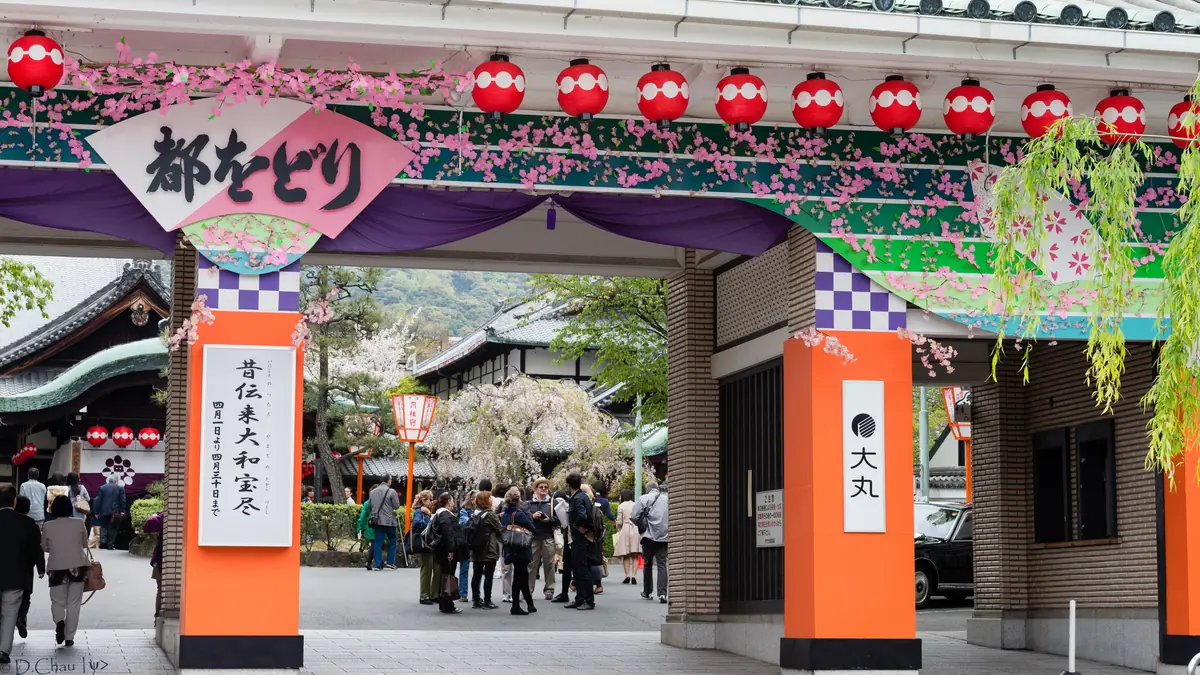
Wikipedia says all Kyoto's hanamachi hold public dances, called odori, every year, mostly in spring with one exclusively in autumn. They feature both maiko and geisha and date to the Kyoto exhibition of 1872. The Miyako Odori of Gion Kobu is one of the four great spring shows of Kyoto's five districts. The Miyako Odori was first celebrated in 1875, held alongside the Kamogawa Odori of Pontochō and the Kitano Odori of Kamishichiken.
The Miyako Odori in detail
Wikipedia gives the Miyako Odori's schedule as four times a day from 1 to 30 April at the Gion Kobu Kaburen-jo theatre near Yasaka Shrine. Maiko and geisha of Gion perform dances, songs and theatre, with motifs from classical Japanese culture, for example the Tale of Genji. A dance may involve 32 maiko and geiko and 20 musicians in identical costumes, often performing in unison. It was first celebrated in 1875, when Kyoto's mayor wanted to draw tourists and revive the city's reputation after the court moved to Tokyo.
Which district is which
Wikipedia says Kyoto's five hanamachi are informally ranked: Gion Kobu, Pontochō and Kamishichiken are seen as the most prestigious, with Gion Kobu at the top, and below them come Gion Higashi and Miyagawa-chō. The Miyako Odori belongs to Gion, the Kamogawa Odori to Pontochō and the Kitano Odori to Kamishichiken. A show does not tell you which district its performer works in, so do not choose by district when you book a ticket like this one.
Programme and repeats
Wikipedia notes a difference in programming: the Kamogawa Odori presents a new programme each year, whereas the Miyako Odori is much the same year after year. If you plan to go to a spring dance, that matters in a small way. A returning visitor to the Miyako Odori sees a familiar production, while the Kamogawa Odori changes. Check each hanamachi's own schedule and booking route for the current year, because dates, seat categories and programmes are set by the districts.
What a show offers instead
The one-hour show on this site is closer to a conversation than a production. The performer is a maiko or a geiko, depending on the day, and the organiser describes two dances of about five minutes each, then questions, photographs and a traditional game, with a guide interpreting. The room holds up to 23 guests in the tea house or up to 40 in the Gion Theater. Instead of 32 performers on stage, one performer is within talking distance, and the booking calendar shows the dates on offer.
Which suits you
Choose a spring dance if you will be in Kyoto in the right month and want the scale: a theatre, an orchestra of musicians and a full cast in matching costume. Choose the show if your dates do not line up with the season, if you would like to ask a maiko questions, or if you want a shorter commitment. Neither replaces the other, because one is a spectacle you watch and the other is a short encounter you take part in.
Who this isn't for
Dates, prices and seat categories for the spring dances are left out here, because they change each year and the districts set them. It also cannot promise that any particular maiko will appear in either format. If you need a firm date outside April, a booked show is the practical choice, and if you need the largest production, check the districts' own pages before you plan around any performance.
Frequently asked questions
When is the Miyako Odori?
Wikipedia gives it as four times a day from 1 to 30 April at the Gion Kobu Kaburen-jo theatre. Check the district's current schedule before planning.
Are there dances outside spring?
Wikipedia says all the Kyoto hanamachi hold public dances annually, mostly in spring and one exclusively in autumn.
Is a booked show the same as a spring dance?
No. A spring dance is a large stage production. The booked show is a short, close performance with questions, photographs and a game.
Which Kyoto districts hold spring dances?
Wikipedia names the Miyako Odori of Gion Kobu, the Kamogawa Odori of Pontochō and the Kitano Odori of Kamishichiken among them.
Does the show use the same dances?
The organiser describes traditional dances but does not name them, and the programme can vary by performer and day.
Sources