The short answer
Seeing a real geisha in Kyoto
Can you see a real geisha in Kyoto? Yes, though rarely by chance. How maiko and geiko differ, where they perform and which show to book.
Book the one-hour geisha show ↗Quick answer
Yes, but rarely by chance. Most women in kimono on Kyoto's streets are visitors who paid to be dressed up for the day. To watch a working maiko or geiko you need a teahouse banquet, one of the public dances in spring, or a booked show. This site's ticket is a one-hour show where the performer is a maiko or a geiko, depending on the day.
Geiko, maiko and what real means
Kyoto calls its geisha geiko, a word Wikipedia translates as woman of art. The apprentice is a maiko, woman of dance. Per Wikipedia she is typically 15 to 20 and studies traditional dance, the shamisen and kouta, short songs, with the Kyoto dialect added in Kyoto alone. Both are performing artists who also host and converse. In the morning maiko take lessons in the traditional arts, and at night they dance, sing, play the shamisen and serve visitors at teahouses. So real here separates a working maiko or geiko from a visitor in a hired kimono, which is what most people mean when they ask.
Read next: Maiko or geiko: what differs
Most kimono on the street are borrowed
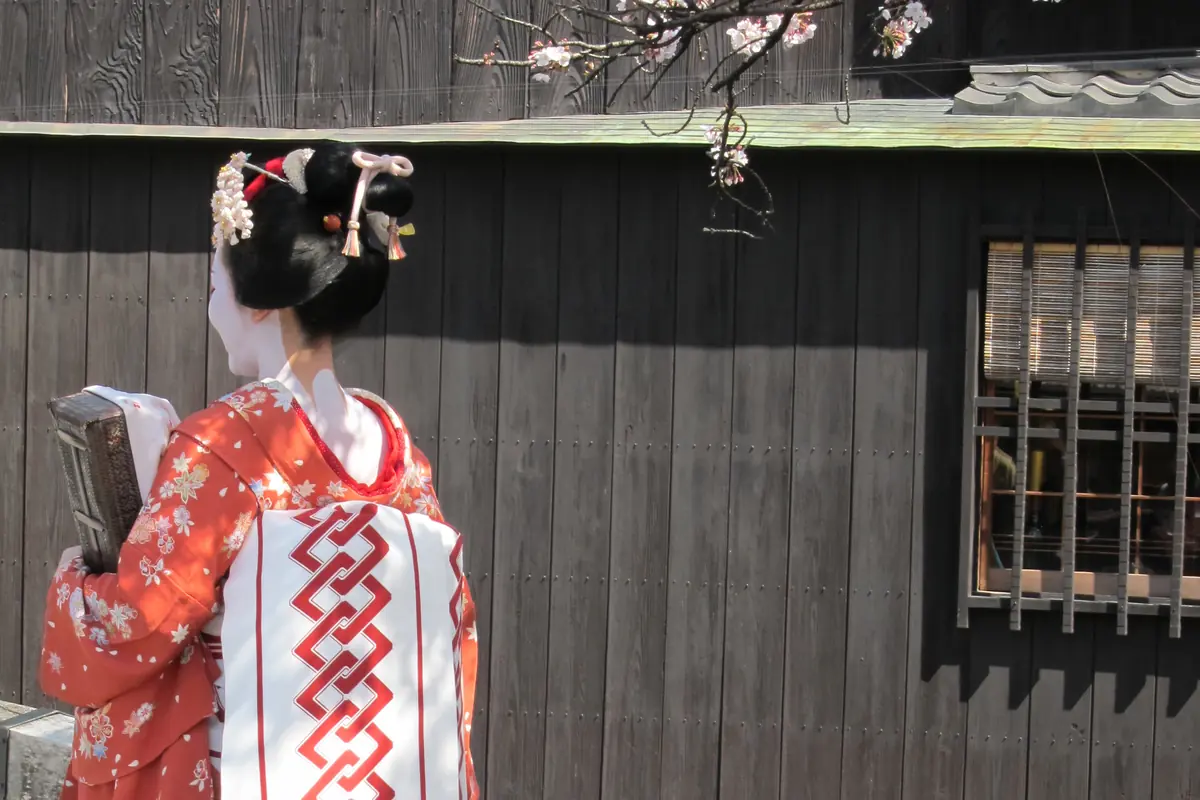
Wikipedia notes that most sightings of geisha and maiko in and around Kyoto are visitors who pay a fee to be dressed up as one for the day, a practice called henshin. Dressing parlours in Gion offer exactly this. Costume can be copied closely, as the photograph shows, so you cannot judge at a glance. Assume anyone dressed this way on the street is a visitor, and never follow or stop a stranger for a photograph.
Five districts, few chance meetings
Kyoto's geisha districts, called hanamachi, number five and are known together as the gokagai: Kamishichiken, Pontochō, Miyagawa-chō, Gion Higashi and Gion Kobu. Wikipedia says geisha generally do not work outside their own district and describes Gion Kobu as informally ranked at the top. At night, maiko work at exclusive teahouses called ochaya. The numbers are small: Wikipedia records 71 maiko and 202 geiko in Kyoto in 2006, and the organiser of this show puts the number of maiko at about 40. Counts differ by year and source, but none makes a street meeting likely. Wikipedia adds that the more prestigious districts are frequented by powerful businessmen and politicians.
The street is not a stage
Kyoto's tourism site is direct about it. Its first rule for visitors: no stopping, touching or following a geiko or maiko, and no unauthorised photos or video of one walking through the district. It adds that they are not mascot characters. Another page explains that a maiko in full dress has an engagement to attend and is in a hurry. The tourist information centre adds that photographing maiko is prohibited in areas such as the Gion-machi South District. The photography guide sets out the rules in full.
Read next: Photographing geisha in Gion
Three proper ways to see one
Kyoto's tourist information centre lists the paid routes, and it says only that near a hanamachi you may be able to see a maiko, which is not a promise. The first three routes below come from that list and the fourth is this site's subject. Each puts a performer in front of you on purpose, so the choice comes down to your month, your budget and how much time you have:
- An ozashiki plan, a banquet-style gathering offered by Japanese-style restaurants and travel agencies.
- A sightseeing bus course where you watch a maiko dance and take a commemorative photo.
- The public dances each hanamachi stages every year, mostly in spring, according to Wikipedia.
- A booked show on a set date, such as the one-hour ticket on this site.
How the spring dances differ
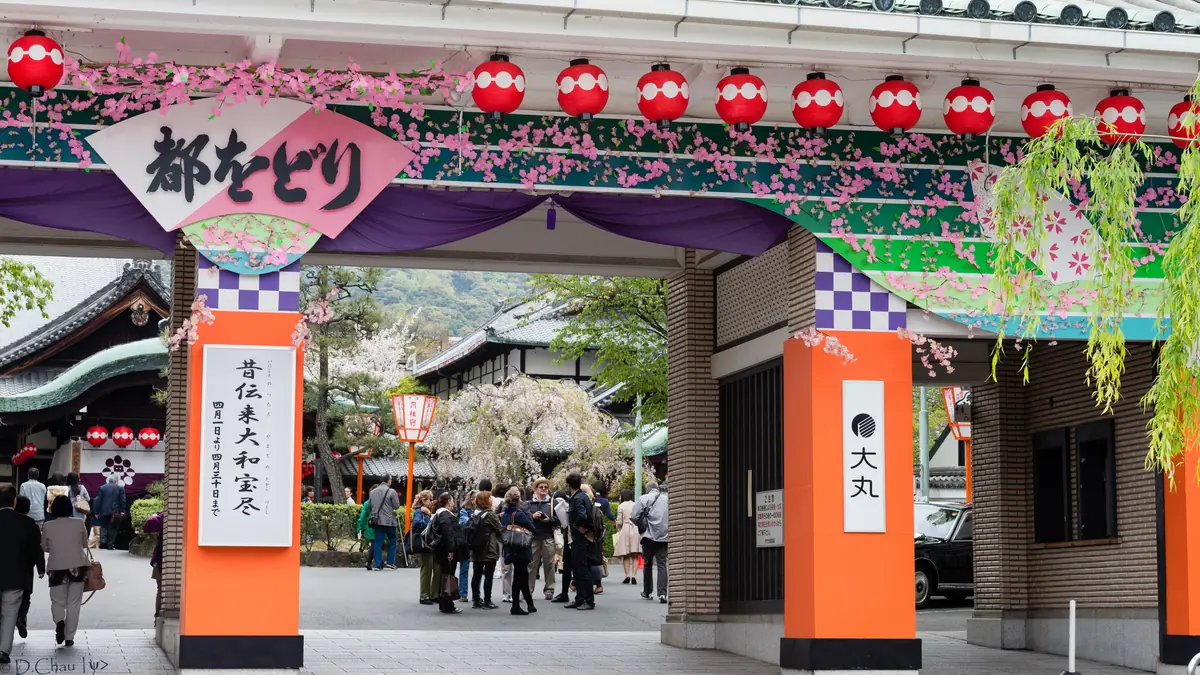
Gion Kobu's Miyako Odori runs four times a day from 1 to 30 April at the Kaburen-jo theatre near Yasaka Shrine, and Wikipedia says a single dance may involve 32 maiko and geiko with 20 musicians in identical costumes. It was first held in 1875. That is a stage spectacle with a fixed season. A one-hour show is the opposite scale: one performer, a smaller room and time to talk, on dates the booking calendar shows.
Read next: Spring dances or a geisha show
What the one-hour show is
The performer is a maiko or a geiko, depending on the day. The organiser describes two traditional dances of about five minutes each, then time for questions, photographs and a chance to play a traditional Japanese game with her. Tea and traditional Japanese snacks come with the ticket, and a guide interprets between English and Japanese. Because it pairs a short performance with conversation, it suits curious visitors more than dance specialists. The next guide follows the hour moment by moment.
Read next: What happens at a geisha show
Tea house or Gion Theater
The organiser says the two options are different tours. The tea house is held in a kyo-machiya, a Kyoto townhouse, for up to 23 guests, and it adds an optional 30-minute session at Kitano Tenmangū shrine. The Gion Theater option is a showhouse for up to 40 guests. Wikipedia describes a typical Kyoto machiya as a long wooden home with narrow street frontage. The organiser warns that this is not a small-group show and asks you to look at the pictures of both rooms before booking. One reviewer calls the evening personal because the venue does not get too crowded, which gives more privacy.
Two shorter alternatives
Two other tickets sit beside this one. A 45-minute meet and greet pairs two dances, eight to ten minutes in all, with an interview and ten to fifteen minutes of photographs. A 15-minute Kyomai dance at a museum in Gion comes with the museum's exhibition, and that ticket is non-refundable. The one-hour show is the longest of the three. Choose by your dates and your evening: April has the Miyako Odori, the shorter tickets suit a tight schedule, and the one-hour show suits time to talk. The 15-minute ticket is non-refundable, while the one-hour show can be cancelled a day before when booked through GetYourGuide.
What travellers praise and what they flag
The one-hour show averages 4.8 from 651 reviews as of this update, and 90% of English-speaking reviewers gave it a perfect score. Travellers praise the informative question session, the guide's translations, the friendly staff and the game. Some say the dance segments feel brief and that more performance time would help. That matches the organiser's own warning that the maiko will not perform continuously for an hour. Book it as a close conversation with two dances in it.
Who this isn't for
A visitor who wants a full hour of continuous dance, the spectacle of a spring stage production, or a private banquet in a teahouse will be disappointed. Nor does it show geisha at their everyday work. Wheelchair users should know that the tea house option is not wheelchair accessible, while the Gion Theater option is. If a few minutes of dance would feel too short, read the spring dances guide before you decide, and if your plans depend on seeing a maiko rather than a geiko, remember that the ticket cannot promise it.
Frequently asked questions
Can I see a real geisha in Kyoto?
Yes, but rarely by chance. Most kimono-clad people on the street are visitors in hired outfits. To watch a working maiko or geiko, book a show or banquet, or attend a public dance.
What is the difference between geisha, geiko and maiko?
Geiko is the Kyoto word for a geisha. A maiko is an apprentice, usually aged 15 to 20 according to Wikipedia, who graduates to geiko after training.
Is the performer a maiko or a geiko?
Either. The organiser says it depends on the day, so the ticket does not promise one or the other.
Can I photograph geisha in Gion?
Not without permission. Kyoto Travel says no stopping or following geiko or maiko and no unauthorised photos, and some parts of Gion prohibit photography.
How long is the show?
The ticket is one hour, with two dances of about five minutes each. The rest is questions, photographs and a traditional game.
Which option should I choose?
Choose the tea house for a smaller room of up to 23 guests and the shrine session. Choose the Gion Theater, up to 40 guests, if you need wheelchair access.
Sources